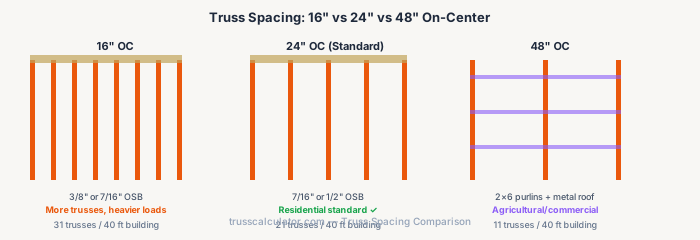
Quick Answer: 24-inch on-center spacing works for most residential roofs with 7/16-inch OSB sheathing. Step down to 16 inches for heavy snow loads (over 50 psf), heavy tile roofing, or if you're using thinner sheathing.
Truss spacing determines how many trusses you need, what thickness of sheathing you can use, and whether your roof system meets code for your local snow and live loads. Most builders default to 24 inches on center, and for most residential projects, that's the right call. But there are specific situations where 16 inches makes sense, and agricultural or commercial applications where 48 inches becomes viable.
Use our truss count calculator to model different spacing options and see how the numbers change before you commit.
The Basics: What On-Center Spacing Means
"On-center" (OC) spacing means the distance from the center of one truss to the center of the next. A 40-foot building with trusses at 24 inches OC requires ⌈40 ÷ 2⌉ + 1 = 21 trusses. At 16 inches OC, that climbs to ⌈40 ÷ 1.333⌉ + 1 = 31 trusses.
That 10-truss difference on a single building matters: at $200 per unit for a 30-foot span Fink truss, 16-inch spacing costs $2,000 more than 24-inch spacing. The additional sheathing and labor for the denser nailing pattern add further cost.
24-Inch On-Center: The Residential Standard
Why It Works
IRC Table R802.4.1 and the AWC's Wood Frame Construction Manual both confirm that 24-inch OC truss spacing is structurally adequate for residential roof systems with:
- 7/16-inch or 1/2-inch OSB or plywood sheathing
- Standard residential live loads (20 psf) and dead loads (15 psf)
- Ground snow loads under 50 psf in most U.S. zones
This configuration is what truss manufacturers design around by default. Lead times are shortest, pricing is most competitive, and every roofing contractor knows how to work with it.
Sheathing at 24-Inch Spacing
With 24-inch spacing, you need a minimum of 7/16-inch OSB or 1/2-inch plywood for the sheathing to span between trusses without deflecting. The APA (Engineered Wood Association) rates 7/16-inch OSB as adequate for 24-inch spans under standard residential loads.
If you use 3/8-inch sheathing at 24-inch spacing, you'll likely see sheathing deflection between trusses, which causes shingles to telegraph (ripple) and reduces wind uplift resistance.
16-Inch On-Center: When to Step Up
High Snow Load Zones
Ground snow loads above 50 psf (common in the Mountain West, parts of New England, and the Upper Midwest) often drive engineers to specify 16-inch OC spacing. More trusses means each one carries a smaller tributary load, which keeps member stress within code limits.
Check your area's ground snow load at the ASCE 7 online hazards tool or your local building department. If your design snow load (which is typically 0.7× the ground snow load, plus additional factors) exceeds what 24-inch spacing can handle, you'll get flagged during permit review.
Heavy Roofing Materials
Concrete tile averages 9–12 lbs/sq ft dead load. Clay tile runs 7–10 lbs/sq ft. Compare that to standard asphalt shingles at 2–3 lbs/sq ft. This extra dead load changes the structural math significantly.
Most truss manufacturers size their standard 24-inch OC trusses assuming 15 psf total dead load. If you're going with concrete tile, discuss this with your fabricator. They may need to upsize the chord or web members, or spec 16-inch spacing, to keep the truss within allowable stress limits.
Thinner Sheathing
If you're using 3/8-inch OSB (sometimes done to reduce cost or weight), you need 16-inch OC spacing. The APA span ratings confirm 3/8-inch OSB maxes out at 16 inches for roof sheathing under standard loads.
48-Inch On-Center: Commercial and Agricultural Applications
Trusses at 48 inches OC are used in pole barns, agricultural buildings, and some commercial structures. The per-unit truss cost is higher (bigger chords, more webbing), but you need roughly half the number of trusses versus 24-inch spacing.
This spacing only works with specific engineered roof systems, usually 2×6 purlins spanning between trusses rather than continuous sheet sheathing. Don't use 48-inch spacing and try to nail OSB directly to the trusses; it won't span that distance under any load.
For a 40×60-foot agricultural building at 48-inch spacing, you'd need about 16 trusses instead of 31 at 24 inches. Even with the per-unit premium, the total truss cost often comes out 15–25% lower. Run both configurations through our truss cost calculator to see the trade-off for your specific building.
How Spacing Affects Your Sheathing Budget
Sheathing cost scales with roof area (which doesn't change with spacing), but nailing pattern and blocking requirements do change:
- At 16-inch OC: nails every 6 inches on edges, 12 inches in the field (more labor)
- At 24-inch OC: nails every 6 inches on edges, 12 inches in the field (standard labor)
- At 48-inch OC: no sheet sheathing; purlins and metal roofing instead
The real cost difference between 16-inch and 24-inch spacing comes from the extra trusses, not the sheathing. For most residential projects, the additional truss cost at 16-inch spacing isn't justified unless the structural load analysis demands it.
Making the Right Call
Start with 24-inch OC and confirm it's adequate for your:
1. Ground snow load (check ASCE 7 or your local building department)
2. Roofing material dead load
3. Sheathing thickness you plan to use
If any of those push you toward 16 inches, get your truss fabricator involved early. They'll run the actual engineering numbers. If you're building agricultural or commercial at scale, 48-inch spacing with a purlin system is worth pricing against standard residential framing.
Plug your dimensions into our roof truss calculator to compare truss counts at all three spacing options before your next supplier call. For more context on how spacing interacts with truss type and cost, see our truss cost breakdown and truss lumber guide.