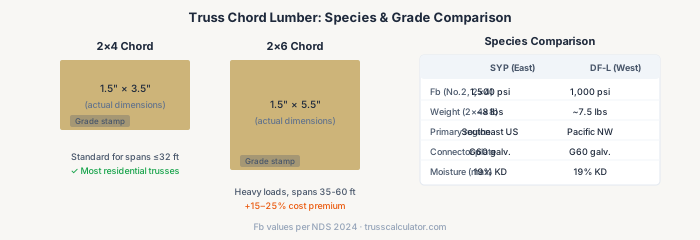
Quick Answer: Most residential trusses use 2×4 or 2×6 No. 2 Southern Yellow Pine (in the East) or Douglas Fir-Larch (in the West). The lumber grade and species are engineered into the truss design. You can't substitute lower grades without a new engineering analysis.
If you're ordering pre-built trusses, the fabricator handles lumber selection. But if you're building site-built trusses, sizing and grading for a DIY project, or just trying to understand why your quote changed when lumber markets moved, this guide explains what's actually going into those trusses.
Run your truss count first using our roof truss calculator. Once you know how many trusses you need, the lumber quantities in this guide become directly applicable.
The Two Most Common Species
Southern Yellow Pine (SYP)
Southern Yellow Pine dominates truss fabrication east of the Rockies. It's dense, strong, and available at low cost from mills throughout the southeastern U.S. The AWC's National Design Specification (NDS) assigns SYP some of the highest design values of any softwood lumber. No. 2 SYP has a bending value (Fb) of 1,500 psi for 2×4 members, higher than most competing species at the same grade.
The downside: SYP is heavy. A 2×4 No. 2 SYP 8-foot stud weighs about 8 lbs; the equivalent Douglas Fir stud weighs about 7.5 lbs. In a 40-truss order, that weight difference matters for crane capacity and delivery weight.
Douglas Fir-Larch (DF-L)
Douglas Fir-Larch is the standard species in the Pacific Northwest, Mountain West, and much of the West Coast. It's slightly lower density than SYP but has excellent strength-to-weight ratio and takes metal connector plates well. No. 2 DF-L has an Fb of 1,000 psi for 2×4 members, lower than SYP but still adequate for most residential truss applications.
Regional availability drives the choice: in Oregon or Washington, DF-L costs less than SYP due to transport savings. In Georgia or North Carolina, SYP is often $50–$100 per thousand board feet cheaper than DF-L.
Lumber Grades Used in Trusses
Standard Chord Lumber: No. 2 and Better
The vast majority of residential truss chords (the top and bottom members that form the roof slope and ceiling line) use No. 2 grade lumber. "No. 2 and better" means the piece meets or exceeds No. 2 grade, the minimum grade with acceptable knot size, slope of grain, and wane for structural applications.
No. 2 lumber has visible defects: knots up to 3/4 of the narrow face width, moderate slope of grain, and limited wane. These defects are accounted for in the lumber's design values. The engineering tables in the NDS already assume No. 2 grade properties.
Why not use Select Structural? Select Structural (SS) lumber has higher design values, which means smaller members could theoretically carry the same load. But SS costs 20–40% more than No. 2, and most residential truss designs don't require the upgrade. The fabricator will spec SS or machine stress-rated (MSR) lumber only where the span or load demands it.
MSR and MEL Lumber for Long Spans
For longer spans or higher loads, truss manufacturers often specify Machine Stress-Rated (MSR) or Machine Evaluated Lumber (MEL). Every piece of MSR/MEL lumber is run through a machine that tests its actual stiffness before it's graded, so the design values are more consistent than visually graded lumber.
MSR lumber is labeled with its E (modulus of elasticity) and Fb values directly on the grade stamp. You'll see ratings like "1650Fb-1.5E" or "2100Fb-1.8E." Higher numbers mean you can use smaller members for the same span, which reduces weight and sometimes cost.
For spans over 40 feet or in high-load zones, expect MSR lumber in the bottom chord and possibly the top chord. This adds to fabrication cost but is required to keep the design within code-compliant deflection limits.
Member Sizes: 2×4 vs. 2×6 Chords
2×4 Chords: Standard Residential
Most residential Fink and King Post trusses use 2×4 chord members. The actual dimensions are 1.5 inches × 3.5 inches. The connector plates are sized to bond to this face dimension.
2×4 chords work well for:
- Spans up to about 32 feet with standard residential loads
- Standard 20 psf live load and 15 psf dead load
- 24-inch OC spacing
2×6 Chords: Heavy Loads and Long Spans
When loads or spans push beyond what 2×4 members can handle, the fabricator upgrades to 2×6 chord members (actual: 1.5 × 5.5 inches). This gives more cross-section area and higher bending resistance.
Expect 2×6 chords on:
- Spans over 40 feet
- High snow load designs (40+ psf)
- Trusses supporting a heavy dead load (concrete tile, green roof, equipment)
- Scissor trusses with steep bottom chord angles
2×6 chord trusses cost 15–25% more than equivalent 2×4 chord trusses, both for lumber cost and for the larger connector plates required.
Web Members: Smaller is OK
Web members (the diagonal and vertical members inside the truss frame) are typically 2×4 and sometimes 2×3. They're almost always shorter than chord members and experience lower stress, so the grade requirements are less stringent.
In most residential trusses, web members are No. 3 or Utility grade, the lowest structural grades, but perfectly adequate for the short spans and moderate loads involved. This is one area where truss manufacturers achieve real efficiency over site-built framing: the engineering precisely sizes each member for its actual load rather than defaulting to the largest lumber that fits.
Moisture Content and Treatment Requirements
Kiln-Dried Lumber (KD)
All truss chord and web lumber must be kiln-dried to 19% moisture content or less (KD19) before fabrication. Green lumber shrinks as it dries, which can loosen connector plates and cause trusses to rack after installation. Truss fabricators inspect incoming lumber for moisture content and reject material that doesn't meet spec.
Preservative Treatment
If your building is in a climate where wood decay is a risk (high humidity, coastal areas, or any location where the truss might be exposed to wetting), your fabricator may specify preservative-treated lumber. Standard CCA or ACQ treatment requires special connector plates (G185 galvanized instead of standard G60), adding to hardware cost.
Check your local building code's table of required treatment levels for your specific application (interior/exterior, contact with ground, etc.).
Estimating Lumber Volume for DIY Trusses
If you're building site-built trusses for a small shed project, here's how to estimate lumber:
For each King Post truss on a 16-foot span with 4/12 pitch and 12-inch overhang:
- Two rafters (top chords): rafter length ≈ 9.8 feet each → use 10-foot boards (2×4×10)
- One bottom chord: 16 ft + 2 ft overhang = 18 ft → two 2×4×10s spliced
- One vertical king post: 3.5 feet → cut from scrap
- Gusset plates (wood or metal): 6 gussets
Per truss: roughly 32 linear feet of 2×4 lumber. For 9 trusses: 288 linear feet of 2×4.
For pre-engineered trusses at larger spans, use our truss material calculator to get linear footage counts, then work backward to estimate lumber quantities for site-built alternatives. Compare both options with the cost data in our truss cost guide.