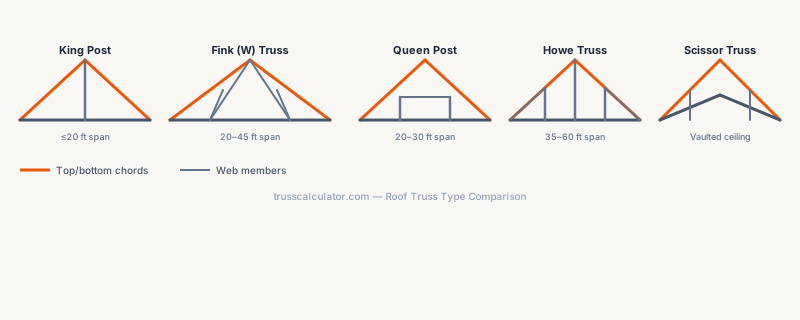
Quick Answer: The Fink (W) truss is the right choice for most residential spans from 20 to 40 feet. King Post works for spans under 20 feet. Scissor trusses give you vaulted ceilings but cost more and push harder on your walls.
Picking the wrong truss type for your project wastes money or, worse, creates structural problems down the road. Each design distributes roof loads differently, and what works for a 16-foot shed fails on a 36-foot ranch home.
This guide covers the five truss types supported by our truss span calculator and explains when each one makes sense.
King Post Truss: Simple, Affordable, Limited Span
The King Post is the oldest truss design still in common use. It has two rafters (top chords), a horizontal tie beam (bottom chord), and a single vertical post connecting the peak to the center of the bottom chord.
Best for: Spans up to 20 feet: sheds, carports, covered porches, small garages.
Advantages: Fewest parts, lowest fabrication cost, easy to build on-site with basic carpentry skills.
Limitations: Without secondary webbing, the bottom chord can sag under its own weight for longer spans. Above 20 feet, you need queen posts or full webbing.
A 16×24-foot shed with a 4/12 pitch and King Post trusses at 24-inch spacing needs about 13 trusses. Run those numbers through the truss count calculator to verify before you order.
Queen Post Truss: Stepping Up from King Post
The Queen Post adds two vertical posts instead of one, creating a rectangular opening at the top of the truss. This makes it better for spans in the 20–30-foot range and works well where you want usable attic space in the center.
Best for: Spans 20–30 feet, barns, agricultural buildings, older-style residential homes.
Cost: About 10–15% more than King Post for the same span, due to additional webbing.
The Queen Post fell out of favor for new residential construction because the Fink truss handles the same spans more efficiently. You'll still see it specified for restoration work on older buildings and in agricultural applications where the open center panel is useful for hay storage or mechanical equipment.
Fink (W) Truss: The Residential Standard
The Fink truss (also called the W-truss) dominates residential construction for good reason. It uses a W-shaped web pattern that breaks long members into shorter segments, reducing the bending stress in each piece. The result is a truss that handles 20–45-foot spans with less lumber than any other common design.
Best for: Standard residential homes, garages, and any span from 20 to 45 feet.
Why it's the default: The Structural Building Components Association (SBCA) estimates Fink trusses account for roughly 70% of all residential truss production in North America. Every truss manufacturer stocks them, lead times are short, and structural engineers know exactly how to specify them.
Cost: Mid-range. A 30-foot Fink truss typically runs $175–$220 fabricated and delivered, versus $145–$165 for a 30-foot Queen Post.
If you're building a 30×40-foot home, estimate your Fink truss costs, then compare against the same span with a Howe configuration to see the difference.
Fink Truss and Attic Space
The web members in a Fink truss cut through the attic, so you won't get a clean open floor. If you need usable attic storage or a finished attic room, look at attic trusses (also called room-in-attic trusses), a variant not covered here but available from most fabricators.
Howe Truss: Heavy Loads and Longer Spans
The Howe truss is the Fink's heavier-duty cousin. It uses diagonal members that slope toward the center (opposite orientation from Fink) and vertical steel rods or timber posts for the verticals. This arrangement handles compressive loads well, making it suitable for commercial applications and spans over 40 feet.
Best for: Commercial buildings, agricultural structures, spans 35–60 feet.
Cost: About 10–20% more than Fink for the same span. The diagonal orientation requires more precise joinery.
For a 40×60-foot agricultural building at 24-inch spacing, you're looking at 31 trusses. A Howe truss at that span might run $275–$350 per unit versus $220–$260 for a Fink. That difference multiplies quickly. Use our roof truss cost calculator to model both options before committing.
Scissor Truss: Vaulted Ceilings, Higher Cost
Scissor trusses have pitched bottom chords instead of horizontal ones, which creates a vaulted or cathedral ceiling effect without stick framing the entire roof. The bottom chord slopes upward from the walls toward the ridge, typically at half the roof pitch (so a 6/12 roof pitch produces a 3/12 interior slope).
Best for: Homes or rooms where the owner wants vaulted ceilings without the cost of full structural steel or post-and-beam framing.
The catch: Scissor trusses generate significant lateral (horizontal) thrust at the wall plates. The walls must be designed to resist this outward push, which usually means heavier top plates, additional wall ties, or engineered hold-downs. A structural engineer should review scissor truss designs before fabrication.
Cost: The most expensive standard truss type: typically $6.00/linear foot of span versus $4.50 for Fink. A 30-foot scissor truss might cost $230–$270 per unit.
Read our guide on common truss installation mistakes for more on scissor truss wall connection requirements. It's one of the most frequently botched details in residential construction.
Which Truss Type Is Right for Your Project?
| Truss Type | Span Range | Best Use | Relative Cost |
|---|---|---|---|
| King Post | Up to 20 ft | Sheds, small garages | Lowest |
| Queen Post | 20–30 ft | Barns, older homes | Low |
| Fink (W) | 20–45 ft | Residential homes | Mid |
| Howe | 35–60 ft | Commercial, agricultural | Mid-high |
| Scissor | 20–40 ft | Vaulted ceiling rooms | Highest |
Start with the Fink truss as your baseline for any residential project. If you need a vaulted ceiling, price scissor trusses with your fabricator and have a structural engineer check the wall connections. For spans over 45 feet, get your fabricator involved early. Engineered trusses at that scale need site-specific design.
Before you call a fabricator, run your dimensions through our free truss calculator to get a quick read on truss count, rafter lengths, and rough costs. Then bring those numbers to your supplier as a starting point for their formal quote.
For more on how roof pitch interacts with truss geometry and cost, see our roof pitch guide.