Quick Answer: A fabricated residential roof truss costs $150–$400 per unit in 2026, depending on span, type, and region. A typical 30-unit order for a standard home runs $4,500–$8,000 for trusses alone, plus $1,500–$3,500 for installation.
Roof truss prices get opaque fast once you're talking to suppliers. The quote you get depends on a dozen variables: span, truss type, lumber grade, local market conditions, lead time, and whether delivery and crane are included. This guide breaks down what actually drives the price so you can evaluate quotes intelligently.
Get a rough cost estimate first using our truss cost calculator, then use this guide to understand what the final invoice might look like.
Per-Unit Truss Costs by Type (2026)
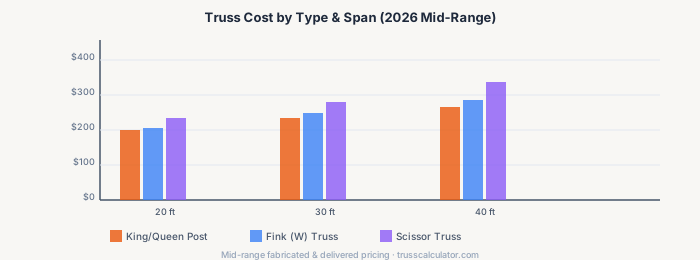
Truss pricing is primarily a function of span and complexity. Here are mid-range per-unit costs for fabricated trusses delivered to your site, based on 2024–2026 SBCA pricing surveys:
| Truss Type | 20 ft span | 30 ft span | 40 ft span |
|---|---|---|---|
| King Post | $120–$160 | $180–$220 | N/A |
| Queen Post | $140–$185 | $200–$250 | $280–$350 |
| Fink (W) | $150–$195 | $190–$240 | $250–$320 |
| Howe | $175–$225 | $225–$285 | $310–$400 |
| Scissor | $195–$260 | $255–$335 | $350–$450 |
These figures assume Southern Yellow Pine (SYP) or Hem-Fir framing lumber at standard residential design loads (20 psf live, 15 psf dead). Engineered lumber, higher snow loads, or custom configurations move the price up.
What's Typically Included vs. Extra
Usually included in the truss quote:
- Engineering drawings stamped by the truss manufacturer's engineer
- Delivery to your site (often with a mileage threshold, typically 50–75 miles)
- Bundle tags and installation layout diagrams
Often billed separately:
- Crane rental for placement ($800–$2,000 per day depending on machine size)
- Temporary bracing materials ($200–$500)
- Truss clips and hurricane ties ($1.50–$3.00 per truss)
- Installation labor (see below)
Always ask your fabricator to itemize delivery, crane, and engineering fees separately. Some quotes bundle everything; others are fabrication-only.
Installation Labor Costs
Setting trusses requires at minimum two people (one on each wall to receive the trusses from the crane) and ideally a four-person crew for faster placement and bracing.
Typical installation rates in 2026:
- DIY placement with rented crane: $800–$1,500 for crane rental + your labor time
- Framing crew: $1.50–$3.00 per linear foot of span per truss, so a 30-foot span truss costs $45–$90 to set, making a 25-truss order $1,125–$2,250 in labor
- Full-service framing contractor (supply and install): 20–30% premium over fabrication-only pricing, but they handle crane, temporary bracing, and final layout
For most owner-builders, renting a crane and setting trusses with a helper is the most cost-effective approach if you have construction experience. If you're not comfortable working at height with heavy loads swinging from a crane, hire a crew. It's not worth the risk.
The Variables That Move the Price
Lumber Market Conditions
Framing lumber prices swung dramatically from 2020 to 2023 and have stabilized somewhat since. Southern Yellow Pine (the most common truss chord lumber in the East) and Douglas Fir (common in the West) both track commodity markets. During high-price periods, truss costs can jump 30–50% from baseline.
When you're budgeting a project more than 6 months out, add a 15% contingency to your truss cost estimate.
Design Loads
Standard residential trusses are designed for 20 psf live load and 15 psf dead load. If your local code requires higher loads, such as coastal wind zones, heavy snow regions, or specific occupancy, the truss manufacturer will upsize members, which adds cost. A 40 psf live load design on the same 30-foot span might cost 15–25% more than the standard design.
Lead Times
Truss fabricators operate on production schedules. Lead times in most markets run 3–6 weeks for standard designs. Rush orders (under 2 weeks) typically carry a 10–20% premium. Plan your order timing around the fabricator's schedule, not your framing schedule.
Regional Pricing Variation
The same 30-foot Fink truss might cost $190 in rural Georgia (close to SYP mills) and $260 in the Pacific Northwest (longer lumber supply chain). Get quotes from at least two fabricators in your region, as the variance can be significant.
Real Cost Example: 30×40-Foot Home
Let's work through a real scenario. A 30-foot wide, 40-foot long home with:
- 6/12 pitch, Fink trusses
- 24-inch OC spacing
- 12-inch eave overhang
- Standard residential loads
Truss count: ⌈40 ÷ 2⌉ + 1 = 21 trusses
Truss cost: 21 × $215 average = $4,515
Delivery (within 50 miles): $0–$350
Crane rental (half day): $900–$1,400
Installation crew (framing contractor): 21 trusses × $65 average = $1,365
Truss clips and ties: 21 × $5 = $105
Total: ~$6,885–$7,735
That's a real-world range for a straightforward residential order. Complex roofs with hip sections, step-down configurations, or custom pitches add engineering time and per-unit cost.
Ways to Reduce Truss Cost
Order early: Lock in pricing with a fabricator 6–8 weeks before you need delivery to avoid rush surcharges.
Standardize your design: The fewer custom cuts, the lower the fabrication cost. Avoid non-standard pitches (7.5/12, 9/12) when a standard pitch (8/12) would work equally well.
Choose 24-inch spacing unless you must use 16-inch: As discussed in our truss spacing guide, 16-inch spacing significantly increases truss count and cost.
Compare Fink vs. Howe for your span: At spans over 35 feet, the cost difference between Fink and Howe narrows, and Howe may be better structurally. Get quotes for both.
Run your building dimensions through our truss cost estimator for a quick baseline, then use these figures to sanity-check supplier quotes. For a look at whether DIY truss fabrication makes economic sense for your project, read our DIY vs. pre-built truss guide.