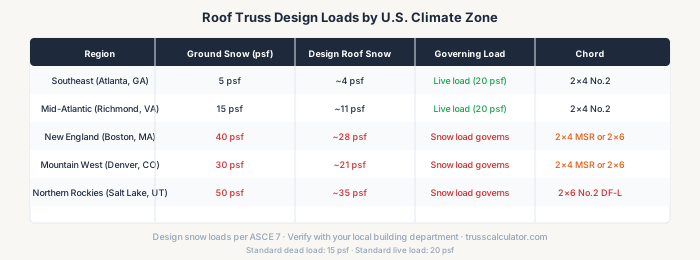
Quick Answer: A standard residential truss is designed for 20 psf live load, 15 psf dead load (total 35 psf), and the local wind uplift requirement. In snow country, add the design roof snow load, often 30–70 psf in New England and the Mountain West.
When you order roof trusses, the fabricator asks for your design loads. Most builders don't think much about this and simply accept the defaults. But those defaults may not match your local code requirements, and getting the loads wrong means under-designed trusses that could fail under a heavy snow or high-wind event.
This guide explains the four primary load types, where to find your local requirements, and how they interact with the truss geometry you calculate using our roof truss calculator.
The Four Primary Load Types
Live Load (LL)
Live load is the temporary, variable load on the roof: maintenance workers, stored items, and light equipment. The IRC defaults to 20 pounds per square foot (psf) for roof live load on residential construction. This is the standard assumed in most residential truss designs.
In most of the continental U.S., snow load (see below) exceeds the 20 psf live load threshold. Where snow load is the governing case, the IRC allows you to reduce the roof live load, but only if your local jurisdiction explicitly permits this in their amendments to the IRC.
What it means for your trusses: The 20 psf live load is built into standard residential truss design. Unless your fabricator tells you otherwise, assume this is included in your quote.
Dead Load (DL)
Dead load is the permanent weight of the roof components: sheathing, roofing material, insulation, and any ceiling system attached to the bottom chord.
Standard residential dead load assumptions:
- Asphalt shingles + 7/16" sheathing: 3–5 psf
- Underlayment and flashing: 1 psf
- Insulation (blown in or batts): 1–2 psf
- Drywall ceiling (1/2"): 2.5 psf
- Total typical dead load: 8–12 psf
Truss fabricators often design to 15 psf total dead load as a conservative standard. This covers asphalt shingles with typical ceiling and insulation.
Where this matters: If you're using heavy roofing such as concrete tile (9–12 psf), clay tile (7–10 psf), or a green/planted roof (15–50 psf), your dead load dramatically exceeds the standard assumption. Tell your fabricator the roofing material weight before they finalize the design.
Snow Load (SL)
In snow country, roof snow load is the controlling structural case. It's typically higher than the 20 psf live load and represents the most stressful demand the roof system faces.
Key terms:
- Ground snow load (Pg): The weight of snow on the ground, mapped by ASCE 7. Values range from near zero in Florida to 150+ psf in parts of Alaska and some Rocky Mountain peaks.
- Design roof snow load (Ps): The load actually applied to the roof, calculated from ground snow load with modifiers for roof slope, exposure, and occupancy. For a heated building with moderate exposure and a 6/12 pitch, Ps ≈ 0.7 × Pg × Ce × Ct.
Sample ground snow loads by region (ASCE 7):
| Location | Ground Snow Load (psf) |
|---|---|
| Miami, FL | 0 |
| Atlanta, GA | 5 |
| Richmond, VA | 15 |
| New York, NY | 20 |
| Boston, MA | 40 |
| Minneapolis, MN | 50 |
| Denver, CO | 30 |
| Salt Lake City, UT | 50 |
| Portland, ME | 60 |
For your specific location, look up the ground snow load using ASCE 7's online hazards tool or ask your local building department.
What it means for your trusses: If your design roof snow load exceeds 20 psf (the default live load), the snow load governs the design. Your fabricator must design to the higher value. Specifying the wrong snow load, or accepting defaults in a snow country application, is a structural safety issue, not just a paperwork one.
Wind Uplift (WU)
Wind creates upward pressure on the underside of overhangs and suction on the roof surface, both forces that try to pull the roof off the walls. This is the load that hurricane ties and H-clips resist.
The design wind speed is mapped by ASCE 7 by zip code. Hurricane-prone coastal areas face design wind speeds of 130–170 mph; inland areas typically design for 90–115 mph. Higher wind speeds require larger connector hardware and additional uplift ties.
What it means for your trusses: The truss fabricator accounts for wind uplift in the connector plate design at the bearing points. The connector hardware (H-clips, hurricane ties) is specified based on your local wind speed. Your building department will verify that the connectors match the wind zone requirements at inspection.
Regional Design Load Examples
Here's how design loads translate to actual truss specifications for a standard 30-foot span Fink truss at 24" OC:
| Region | Governing Load | Chord Size | Approximate Unit Cost |
|---|---|---|---|
| Southeast coastal (low snow, high wind) | Wind uplift governs | 2×4 No. 2 SYP | $190–$220 |
| Mid-Atlantic (20 psf snow) | LL governs | 2×4 No. 2 SYP | $185–$215 |
| New England (50 psf ground snow) | Snow load governs | 2×6 No. 2 SYP or 2×4 MSR | $230–$280 |
| Mountain West (60 psf ground snow) | Snow load governs | 2×6 No. 2 DF-L | $250–$310 |
These aren't exact. Every site and design is different. But they illustrate how loads drive truss cost. A high-snow-load project that accepts default 20 psf design loads could end up with structurally inadequate trusses that sail through fabrication and fail during the first heavy winter.
Getting the Loads Right
Before ordering trusses:
1. Look up your ground snow load: use the ASCE 7 online hazards tool or ask your building department
2. Calculate your dead load: identify your roofing material and ceiling system, look up their weights
3. Confirm your wind exposure category: your fabricator needs Exposure Category B, C, or D (B is most common inland)
4. Give all four values to your fabricator explicitly: don't assume they'll ask if your numbers differ from defaults
Once you know your loads, use our truss span calculator to see how your building dimensions look with standard residential loads. Then provide the actual design loads to your fabricator for the formal engineering.
For more on how design loads interact with truss spacing decisions, see our truss spacing guide. For permit submission requirements in high-load zones, read our truss permit drawings guide.