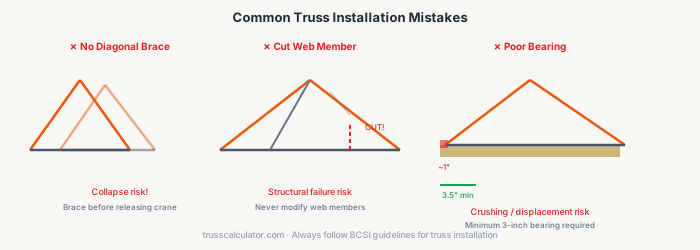
Quick Answer: The seven most critical truss installation mistakes are: missing temporary bracing, improper bearing, cutting web members, ignoring lateral restraint, wrong connector hardware, poor handling before installation, and skipping the BCSI installation guidelines.
Roof trusses are engineered components. They perform as designed only when installed exactly as the manufacturer specifies. Deviations from the design, even seemingly small ones, can compromise the structural integrity of an entire roof system.
Here are the seven mistakes that show up repeatedly on job sites, drawn from failure analysis reports published by the Structural Building Components Association (SBCA) and the Building Component Safety Information (BCSI) guidelines.
Mistake 1: Inadequate Temporary Bracing
This is the leading cause of truss collapses during construction. Trusses leaning against each other without proper diagonal bracing can topple like dominoes. The SBCA's Guide to Good Practice for Handling, Installing, Restraining & Bracing Metal Plate Connected Wood Trusses (BCSI) documents dozens of collapses tied to this failure.
What the standard requires: The BCSI specifies that diagonal bracing (at 45°) must be installed from the first truss to a fixed anchor point before you release the crane. For a gable roof, this means bracing the first truss to the end wall with multiple diagonal boards before setting any more trusses.
On-site reality: Crews in a hurry often lean 5–10 trusses before installing any bracing. The wind picks up, or someone bumps a truss, and the whole stack goes.
Before you start setting trusses, build your first truss brace: a diagonal from the top chord to the end wall, in place before the crane hook is released. The BCSI guidelines are available free from the SBCA website. If you're ordering trusses and asking about proper installation, the manufacturer will often supply a copy with your order.
Mistake 2: Improper Bearing Length
Each truss is engineered with a specific bearing length at the bottom chord ends: typically 3.5 inches for a 2×4 top plate or 5.5 inches for a 2×6. The bearing zone is where the truss transfers its load to the wall.
The mistake: Setting trusses off-center on the plate so the bottom chord bears on only 1–2 inches of plate. This concentrates load on a smaller area, can cause crushing of the plate or splitting of the truss chord, and violates the fabricator's installation requirements.
How to catch it: Your fabricator's shop drawings specify the required bearing length. Check this before the first truss goes up. If your wall plates are out of level or not plumb, correct them before truss installation. Don't compensate by shifting the truss position.
Mistake 3: Cutting or Notching Web Members
Once a truss is in place and the ceiling is being framed, it's tempting to notch or cut a web member to create clearance for a duct, pipe, or electrical run. This is almost always wrong.
Why it matters: Every web member in a truss is a load-carrying element. Cut it, and you've changed how the entire truss distributes loads, typically pushing stress into adjacent members beyond their allowable limits. A truss with a cut web might not fail immediately. It might fail 10 years later under a heavy snow load.
If you need to route utilities through a truss, contact the original truss manufacturer. They can run a revised engineering analysis and may be able to specify a modified web pattern, a "utility opening" in the design, or a repair plate to compensate for the modification. This process costs a few hundred dollars. It's not optional.
Mistake 4: Missing Lateral Restraint on Compression Members
Long compression members (top chords and some web members) can buckle under load if they're not laterally restrained. The truss manufacturer's drawings specify where lateral restraint (LR) is required and at what spacing.
Common failure mode: The installation crew reads "brace every 10 feet" on the drawing but forgets to install the diagonal ties that connect that lateral restraint to a stiff point. A lateral restraint board that can move isn't actually restraining anything.
The fix: For every lateral restraint installation, also install a diagonal tie back to a point of stiffness: typically a gable end wall or a vertical chase member. The BCSI specifies this requirement in detail. Your truss manufacturer's installation drawings will show the required restraint locations.
Mistake 5: Wrong Connector Hardware
Trusses connect to the wall top plates with metal connector hardware: typically metal hurricane ties (H clips) and sometimes framing angles. The correct hardware is specified in the fabricator's drawings based on the required uplift resistance for your wind zone.
The mistake: Using whatever hurricane ties are already in the tool bag, regardless of whether they match the specified connector. A Simpson H2.5 has a different rated uplift capacity than an H10. Using the wrong one means your connection is under-designed for your wind loads.
How to avoid it: Order the specified hardware at the same time as your trusses. Most truss manufacturers will list the required connector model in the shop drawings. In hurricane and high-wind zones, skipping or substituting connectors is a code violation that will fail inspection.
Mistake 6: Improper Handling Before Installation
Trusses are strong as assembled units but vulnerable to damage when handled incorrectly. The most common damage modes:
- Single-point lifting: Lifting a truss by grabbing one chord without a spreader bar can bow the chord permanently
- Flat stacking on uneven ground: Stacking trusses flat on uneven dunnage or the ground can permanently deflect the chords before they're even installed
- Dragging on the ground: Drags on rough ground damage metal connector plates and can dislodge them
Storage best practice: Store trusses upright (on their edges, as they will be installed) in a dry location, supported every 8–10 feet. If stacking flat is unavoidable, support them at the specified bearing points, not at midspan.
A damaged truss is not a "good enough" situation. Contact the manufacturer before installing any truss that has a bent chord, cracked lumber, or displaced connector plates.
Mistake 7: Ignoring the Manufacturer's Installation Package
Every truss order includes installation instructions, a bracing plan, and lateral restraint diagrams specific to your project. These documents are often still bundled and unread when the framing crew shows up.
The BCSI is the industry standard for truss installation, but your specific fabricator's drawings may have additional requirements for your unique design. Crews who've "installed a thousand trusses" sometimes assume the next project is the same as the last. It often isn't.
The requirement: IRC Section R802.10.3 requires that trusses be installed in accordance with the manufacturer's instructions. If the drawings get ignored and something fails, the contractor has no defense.
Before installation day, give the framing crew the fabricator's drawings and the relevant BCSI sheets. Walk through the bracing requirements before the first truss goes up. Ten minutes of pre-installation review prevents the most costly mistakes.
Before You Order
Use our roof truss calculator to verify your span, pitch, and truss count before ordering. Correct dimensions on the front end prevent the most basic fit problems. For more on how to measure accurately, see our building span measurement guide.
Once trusses are ordered, review the shop drawings with your framing crew before the delivery date. The mistakes above are preventable. They happen because no one reviewed the instructions ahead of time.