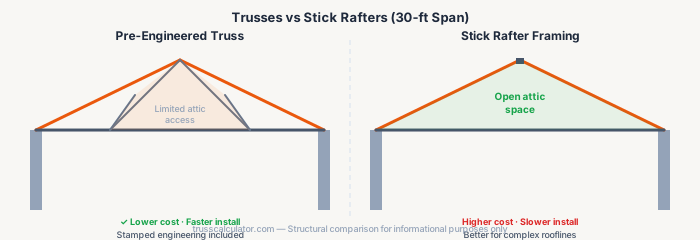
Quick Answer: Trusses win on cost, speed, and structural consistency for most new residential construction. Rafters are better when you need maximum attic space, complex rooflines, or you're adding onto an existing stick-framed house.
The trusses-versus-rafters debate is one of the most common questions in residential construction. Both systems work. The choice comes down to your specific project, timeline, and what you plan to do with the attic space.
For trusses, you can estimate your material count and cost in minutes using our truss calculator. Rafter sizing requires consulting span tables from the AWC or your structural engineer.
How Each System Works
Trusses are pre-engineered triangular frames manufactured off-site and craned into place. The top chords form the roof slope, the bottom chord creates the ceiling line, and a web of diagonal and vertical members distributes loads efficiently. Each truss is a complete, self-contained structural unit.
Rafters (stick framing) are individual lumber members cut and assembled on-site. Each rafter runs from the ridge board to the wall plate, with separate ceiling joists spanning between walls. It's the traditional method. Every house built before the 1960s used it.
Cost Comparison
For new residential construction, trusses typically cost 10–25% less than equivalent stick framing when you factor in lumber, labor, and time.
Why trusses are cheaper:
- Factory fabrication is faster and wastes less lumber
- Installation is much faster (a crane sets 20 trusses in a morning; a crew might take 2 days to cut and raise equivalent rafters)
- Less skilled labor required on-site; setters follow a pre-designed layout
When rafters can cost less:
- On very small projects (under 20-foot spans) where a few boards and a skill saw are all you need
- When you already have lumber on hand
- In remote locations where truss delivery is expensive
For a 30-foot span at 24-inch OC spacing, expect to pay roughly $180–$220 per Fink truss fabricated and delivered. Compare that to hand-cut rafters: the lumber cost per rafter might be similar, but the labor time is 3–5× longer and requires a more skilled framer.
See our 2026 truss cost guide for detailed per-unit pricing by truss type and span.
Attic Space: The Biggest Trade-Off
This is where rafters win clearly. Stick-framed rafters with ceiling joists leave the entire attic volume open, usable for storage, HVAC equipment, or a finished living space with the right design.
Standard Fink trusses run web members through the attic, cutting the usable volume into irregular triangular spaces. You can store lightweight items in the corners, but it's not walkable or finish-able as living space.
If you want a finished attic or accessible attic room:
- Specify "room-in-attic" trusses from your manufacturer (also called attic trusses or storage trusses). These cost 20–40% more than standard Fink trusses, but they provide a clear-span interior space.
- Or use stick framing and add a structural ridge beam.
For cathedral ceilings, scissor trusses can provide a vaulted interior without the cost of a structural ridge beam, but they're more expensive than standard trusses and require more careful wall design. Read our roof truss types guide for scissor truss specifics.
Installation Speed
A professional framing crew using a rough timeline:
| Method | 2,000 sq ft home | Required crew |
|---|---|---|
| Trusses | 1–2 days | 3–4 people + crane operator |
| Stick rafter framing | 4–7 days | 3–5 experienced framers |
The speed advantage of trusses is significant on a construction schedule. Faster roof closure means faster weathering-in, which means earlier progress on interior work and potentially a faster project completion.
For owner-builders who are also serving as general contractor, fewer days of crew time on the roof directly reduces labor costs. Most crane rental companies charge by the half-day or full day, typically $800–$1,500 for a residential truss pick.
Design Flexibility
Stick framing has a real edge for complex rooflines: intersecting gables, dormers, hip roofs, valleys, and unusual angles are much easier to execute with individual rafters cut to fit than with pre-engineered trusses.
Truss manufacturers can design custom trusses for hip roofs and complex configurations, but it requires more engineering time, longer lead times, and higher unit costs. A simple gable roof is where trusses shine. A complex Victorian with six different roof planes is where a skilled stick framer earns their pay.
Structural Performance
Both systems, when properly designed and installed, meet or exceed IRC requirements for residential construction. Trusses have the advantage of engineered consistency: every unit is manufactured to the same standard. Site-built rafters depend more heavily on the skill of the framing crew.
The key structural difference shows up in long spans. A 36-foot rafter requires a large lumber member (2×12 or LVL) to avoid excessive deflection, whereas a 36-foot Fink truss handles the same span with smaller chord members because the web system distributes the load. This is why trusses dominate in wide-span applications.
When to Choose Trusses
- New residential construction with a simple to moderately complex roofline
- Projects where schedule matters and crane access is available
- Any span over 20 feet where the engineered consistency of factory trusses simplifies permitting
- Budget-conscious projects where labor cost needs to be minimized
When to Choose Rafters
- Additions to existing stick-framed homes (matching the existing framing system is usually easier)
- Complex rooflines with multiple intersections, dormers, or curved elements
- Projects in remote areas where truss delivery is impractical
- When maximum attic access is required and room-in-attic trusses aren't in the budget
The Bottom Line
For a standard gable-roof home or garage, trusses almost always make more sense in 2026. The combination of lower total cost, faster installation, and engineered documentation for permits is hard to beat.
Use our truss count and cost calculator to see what a truss system would cost for your building, then compare it to rafter quotes from your local lumber yard. The numbers make the decision easy.