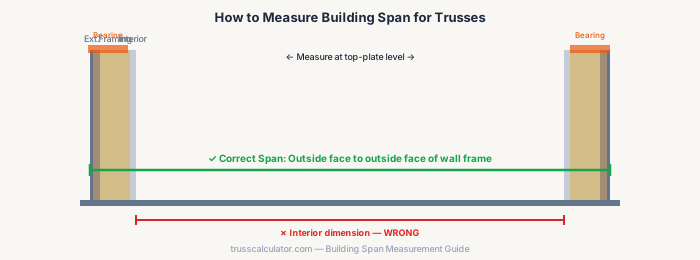
Quick Answer: Building span for truss design is measured from the outside face of one wall framing (not interior finish) to the outside face of the opposite wall. Include wall sheathing if it's already in place. Get this number wrong and your trusses won't fit.
Truss fabricators need an accurate building span to engineer and cut your trusses. Measure wrong, and you'll either have gaps at the bearing points or trusses that overhang too far and can't be seated correctly. This is one of the most common causes of truss fit problems on job sites.
This guide walks through exactly how to measure span, what to include and exclude, and how the number feeds into our truss dimension calculator.
What "Span" Means in Truss Design
Span is the distance the truss must bridge: from bearing point to bearing point. For a standard gable roof on a wood-framed wall, the bearing points are the top plates of the exterior walls.
The span equals the distance from the outside face of one wall's top plate to the outside face of the opposite wall's top plate.
This is typically the same as the outside-to-outside dimension of the framed wall (before any exterior sheathing or cladding is applied). Some fabricators define it slightly differently. Always confirm which dimension they want before submitting your order.
Step-by-Step Measurement Guide
Step 1: Identify Your Wall System
Before measuring, understand what your walls consist of:
- Platform frame (most common): 2×4 or 2×6 studs, with a double top plate. The truss bearing surface is the top of the double plate.
- Concrete block or CMU: The bearing surface is the top of the block wall or the bond beam.
- Structural Insulated Panels (SIPs): The bearing surface is the top of the SIP panel.
For standard wood framing, the exterior dimension of the framed wall is your span. If the building is 24 feet wide with 2×6 exterior walls, the framed wall span is 24 feet (the 2×6 plates are already included in that measurement).
Step 2: Measure at the Wall Plate Level
Measure across the building at the height where the trusses will land: the top of the wall plates. Don't measure at the floor or at mid-wall height; the wall may not be perfectly plumb, and a small lean over 8–10 feet of wall height creates a measurable error at the top.
Use a tape measure and have a helper hold one end at the outside face of the opposite wall's top plate. Measure to the outside face of the near wall's top plate.
Important: Measure in multiple locations along the building length. Buildings are rarely perfectly rectangular. Corners can be out of square, and walls can bow slightly. Record the maximum span dimension and use that for your truss order; trusses can always be shimmed slightly for minor under-span, but an over-span truss won't seat properly without cutting.
Step 3: Account for Sheathing Status
If your walls already have exterior sheathing (OSB, plywood, or foam) applied, measure to the outside face of the sheathing. The truss will bear on the top plate, but the exterior dimension including sheathing determines whether the truss overhang extends properly past the wall face.
Standard 7/16-inch OSB sheathing adds 0.44 inches per side, call it 7/8 inch total across the span. This is usually within the acceptable bearing tolerance for a standard 2-inch seat cut, but tell your fabricator whether sheathing is included in your measurement.
Step 4: Verify with Your Foundation or Slab Dimensions
Cross-check your wall measurement against your foundation or slab dimensions from your plans. If your plans show a 28-foot foundation width and your wall measurement comes back at 28 feet 2 inches, one of those is wrong. Figure out which before ordering.
Common Measurement Mistakes
Measuring Interior Dimension Instead of Exterior
The most frequent error. If you measure from the inside of one wall to the inside of the other, you've missed the thickness of both wall frames. For 2×6 framing: 2 × 5.5 inches = 11 inches short. A truss designed for that measurement will overhang 11 inches past the wall on each side when it lands. That is a serious fit problem.
Using Plan Dimensions Without Verification
Architectural plans often show nominal dimensions, not actual framing dimensions. A "24-foot" building on a plan might be 24 feet to the outside of the stud or 24 feet to the outside of the sheathing. Verify on-site with a tape measure.
Not Accounting for Non-Square Corners
If the building footprint is slightly out of square (a common occurrence in residential construction), the span measured from corner to corner may differ from the span measured mid-building. Always measure at least three points along the length and use the maximum.
Confusing Span with Building Width on Hip Roofs
For a hip roof, the trusses change length as they move away from the center ridgeline. The "span" is still the same overall building width, but the common trusses only run in the middle portion of the building. Your fabricator will ask for hip framing details separately.
How Span Feeds Into the Truss Calculator
Once you have your accurate span measurement, enter it in the "Building Span (Width)" field of our truss calculator. The calculator uses this to determine:
- Peak height: rise = (span ÷ 2) × (pitch ÷ 12)
- Rafter length: √((run + overhang)² + rise²) where run = span ÷ 2
- Bottom chord length: span + (eave overhang × 2)
For a verified 30-foot span with 6/12 pitch and 12-inch overhang, the calculator produces a rafter length of 17.9 feet and a peak height of 7.5 feet. These numbers go directly on your permit drawings and truss order.
Working with Your Fabricator
When you submit your truss order, tell your fabricator:
1. The exact span you measured (not rounded), measured to the outside of the wall frame
2. Whether sheathing is included in the measurement
3. The bearing condition (double top plate, single plate, CMU, etc.)
4. Any slope or level issues with the top plates
Most fabricators build in a small tolerance, typically ±1/8 inch, for dimensional variation. If your span measurement is between two stock dimensions, they'll fabricate to the larger dimension and note the intended bearing location on the drawings.
Run your span through our truss design calculator to get preliminary numbers you can discuss with your fabricator. For more on what goes wrong during truss installation, see our guide to common truss installation mistakes.